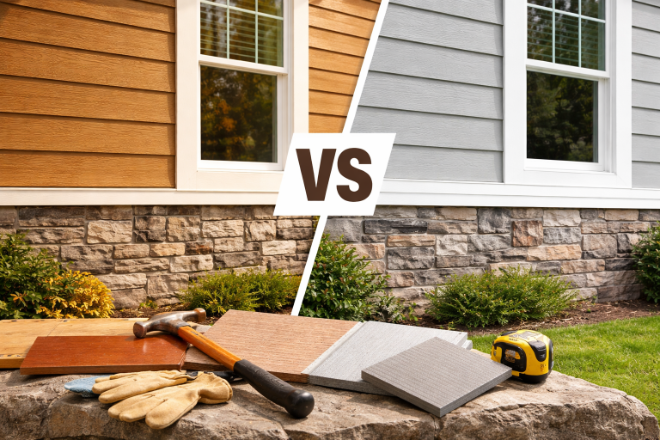
Hardie Board vs Vinyl Siding in Alberta: A Practical Comparison
Both materials are legitimate choices for Calgary homes. The right one depends on budget, architecture, and ownership horizon — not marketing.
Siding is the single largest exterior surface on most Alberta homes, and the choice between Hardie board (fibre cement) and vinyl drives far more of your home’s long-term cost and curb appeal than most homeowners realize. The Alberta siding market has two clear leaders — James Hardie’s fibre cement product and various vinyl brands — with each product answering a different set of priorities.
This guide compares the two honestly. Both are legitimate choices for Calgary homes. Neither is universally best. The right answer depends on budget, architectural context, maintenance appetite, and how long you plan to own the home. This article lays out the trade-offs so the decision comes from information rather than salesmanship.
What each material actually is
Vinyl siding is extruded polyvinyl chloride — PVC — with UV stabilizers and colour pigments integrated throughout the material. The product has been refined since the 1960s and now represents the majority of new residential siding installed in North America. Vinyl comes in horizontal lap profiles, vertical board-and-batten, shakes, and scalloped fish-scale patterns. Modern premium vinyl has dramatically improved from the thin, faded products of 20 years ago — though budget vinyl still exists and still fades.
Hardie board (James Hardie Building Products) is a composite of Portland cement, sand, and cellulose fibres, pressed into plank or panel form and cured. The material is non-combustible, resistant to rot and insects, and holds paint better than almost any other exterior cladding. Hardie has largely displaced traditional wood siding in the premium market since its introduction in the 1990s.
The products look superficially similar at a distance but differ dramatically in texture, weight, installation, and lifecycle performance. Up close on a home, the difference is usually obvious to a trained eye — though good vinyl installation can narrow the visual gap considerably.
The cost reality
For a typical 2,000 square foot Calgary home requiring approximately 2,000 square feet of siding (accounting for gables and returns), installed costs in 2026 run as follows.
Vinyl: $14,000 to $22,000 depending on product tier, architectural complexity, and any insulation backing. Premium vinyl with insulation runs toward the upper end; basic builder-grade vinyl sits at the lower end.
Hardie board: $28,000 to $45,000 depending on product line (HardiePlank lap, HardieShingle, HardiePanel), colour selection, and architectural detail. Pre-finished ColorPlus products carry a premium over site-painted installations but deliver longer colour retention.
The roughly 2x price difference is real and consistent. It reflects material cost (fibre cement is significantly more expensive per square foot), labour (Hardie requires specialized cutting equipment and takes about 50 percent longer to install), and transportation (the product weighs several times more than vinyl).
Hardie’s premium is often justified on long-duration ownership horizons. Over 40 years, Hardie’s maintenance requirements (repaint every 15 to 20 years) and replacement timeline (50+ years) produce lower lifecycle cost than vinyl’s earlier replacement (25 to 35 years). For 10-year ownership horizons, the math tilts the other way.
Weather performance in Alberta
Alberta’s climate stresses siding in specific ways: hail, UV exposure, wind uplift, and temperature swings that cause materials to expand and contract repeatedly.
Vinyl’s weakness is hail. Modern premium vinyl performs adequately in most Calgary hail events, but significant hail can crack, puncture, or dent panels. Vinyl also becomes brittle below -20°C and can shatter under impact in cold conditions — which means mid-winter hail (rare but possible) produces worse damage than summer hail.
Hardie board’s hail performance is substantially better. The material absorbs impact without cracking or puncturing in all but the most extreme storms, and a Class 4 hail rating on the product is available. This is increasingly material given Calgary’s hail frequency and rising insurance premiums for vinyl-clad homes.
UV performance favours Hardie. Vinyl colour fades visibly over 15 to 20 years, especially on south-facing walls. Hardie retains factory colour for 20 to 25 years with proper finish systems, and repaints cleanly when refresh is needed.
Wind uplift on properly installed vinyl is rarely an issue in Calgary. Improperly installed vinyl can tear free in Chinook events, but this is an installation failure, not a product limitation.
Appearance and resale
Hardie board looks like painted wood at any distance. Vinyl looks like vinyl — increasingly well-disguised vinyl, but still vinyl to a trained eye.
For architecturally significant homes, homes in higher-end neighbourhoods, and homes being prepared for resale above the neighbourhood median, Hardie is generally the better choice. Real estate appraisers and buyers in the premium market recognize and value fibre cement over vinyl.
For mid-market homes, rental properties, and neighbourhoods where vinyl dominates, the premium for Hardie may not be recoverable at resale. The local market is the deciding factor. If adjacent homes have high-quality vinyl, adding Hardie creates a premium that the buyer pool may not pay for; if adjacent homes are Hardie, vinyl may create a visual discount.
Walk your neighbourhood before deciding. The most common siding material on nearby homes tells you a lot about buyer expectations in your specific market.
Installation considerations
Hardie installation requires specialized training and equipment. The material is cut with a carbide-tipped circular saw or a dedicated fibre cement shear — never a regular blade, which creates hazardous silica dust. Proper fasteners, spacing, and flashing detail are critical. James Hardie provides installation training and certifies contractors who complete it.
Vinyl is more forgiving, which is both advantage and disadvantage. Easier installation means more contractors install it, which means bid prices are competitive. It also means that many contractors install vinyl without understanding the details that prevent 5-year waviness, buckling in hot sun, and panel separation.
Both materials need proper weather barrier, flashing, and integration with windows and roof edges. Shortcuts at those interfaces cause leaks regardless of which siding is on top.
Ask any prospective contractor for their James Hardie certification number if bidding Hardie, and for photographs of vinyl installations past year 8 if bidding vinyl. Both questions filter out contractors who will underperform.
Insulated vinyl: a meaningful upgrade
Standard vinyl siding is mechanically straightforward but offers minimal insulation value. Insulated vinyl — vinyl panels backed with a contoured rigid foam insulation that fits snugly against the panel — addresses this gap and is worth understanding when comparing bids.
The contoured foam adds R-2 to R-4 of continuous exterior insulation, which is meaningful in Calgary’s climate where wall heat loss is a significant share of total winter energy use. The rigid backer also stiffens the panel, reducing the wavy appearance that plagues older vinyl installations and improving impact resistance against hail.
The price premium is modest — typically $1.50 to $3 per square foot above standard vinyl — and the energy savings often pay back the upgrade over the panel’s service life. For Calgary homeowners committed to vinyl, insulated vinyl is usually the better choice unless budget is severely constrained.
Hardie does not currently offer an equivalent insulated panel system, though continuous exterior rigid insulation can be installed beneath Hardie as a separate layer at additional cost.
The fire and insurance dimension
Fire performance is a growing concern in Alberta as wildfire smoke and ember exposure increase. Hardie board is non-combustible and carries a Class A fire rating — the highest available. Vinyl melts under direct flame exposure and contributes fuel to structure fires.
For homes on Calgary’s outskirts, acreages, and rural properties, the fire rating of exterior cladding is increasingly a factor insurers consider. Some carriers now offer premium discounts for non-combustible exterior materials, and in certain high-risk zones, vinyl may not qualify for standard coverage at all.
Urban Calgary homes face less wildfire exposure but still benefit from non-combustible cladding in shared-wall situations, townhome developments, and properties near structures that could be a fire source.
The decision that fits your home
The Hardie-versus-vinyl decision is genuinely situational. For long-term ownership of architecturally significant Calgary homes, Hardie’s cost premium pays back. For budget-constrained projects, rental properties, or mid-market homes where premium pricing isn’t supported by the neighbourhood, quality vinyl delivers strong value at a much lower price point.
The worst decisions come from choosing based on initial bid price alone. A $14,000 vinyl job on a home that would have supported $35,000 Hardie caps the home’s resale value. A $40,000 Hardie job on a rental property produces unrecoverable costs.
Calgary siding contractors who install both products honestly walk homeowners through the trade-offs — and sometimes recommend the cheaper option when it’s the right answer. That’s the conversation worth having before committing to either material.
About the author — this article was contributed by Angel’s Roofing, a Calgary roofing and exterior renovations contractor. The company installs Hardie board, vinyl siding, custom cladding, and ACM panels across Calgary and southern Alberta with in-house crews.